
In my daily work, I constantly meet people who are not familiar with the world of SAP technologies. This means that us SAP professionals who speak the lingo must approach those new to SAP with special care.
Especially S/4HANA terminology has raised a lot of interest. As I have talked to countless number of people interested in the system, I have seen that the following questions are constantly discussed. What is S/4HANA and how does it work? Is it a database? Is it an Enterprise Resource Planning tool? So, without further ado, welcome, SAP rookies!
So, what exactly is S/4HANA?
SAP S/4HANA is the next generation business suite designed to help organization navigate through the connected and digital world. It has been built upon a revolutionary in-memory platform that offers users a unique user experience via its intuitive user interface. It is a fundamental solution that covers the critical business processes within companies. SAP S/4 HANA is not only an enterprise resource planning system but an interesting combination of different technologies, products and solutions.
For over four decades SAP’s tool, SAP ERP, was a pivotal product for the German technology giant. Therefore, it is no wonder that SAP’s CEO, Bill McDermott, described the introduction of S/4HANA as the “biggest launch in 23 years, if not in the entire history of the company”.
It all began with HANA
So, what separates SAP S/4HANA from previous generations of SAP ERP? Biggest clue to the answer is in its name.
The original HANA database, first introduced in 2010, has been fundamentally built on new architecture. It operates in-memory and data is saved in columns which enables faster and real-time analyses and complex calculations.
Towards S/4
This brings us to SAP S/4HANA which is a next generation business solution. It has been built on SAP HANA and comes with the modern Fiori user interface.
S/4HANA delivers all ERP core functionalities to a single location that houses a common data warehouse. Furthermore, it has been engineered to enable organizations to operate under different circumstances. The core technologies of S/4HANA allow companies to centralize and streamline a solution for handling increased amounts of data coming from, for instance, IoT or online marketplaces.
SAP S/4HANA offers a wide range of solutions and innovations that simplify daily functions. For instance, although in the previous versions of SAP ERP financial accounting was very efficient, information was kept and processed in silos. Having separate modules and their individual tables serve as a perfect example of this.
This way, a single organization with SAP ERP would get its data from hundreds of different header and line item tables. If the organization wanted to process or report financial information, data was needed to be compiled from several different tables. Furthermore, these tables were not necessarily under the same structure but might have been in different modules. This meant that data acquisition and consolidation was complicated and had a significant effect on system performance.
SAP S/4HANA is the digital core for enterprises. It combines internal and external elements into a single living structure that goes beyond a traditional ERP system. The most obvious advantages are the use of new and scalable user interfaces, better accuracy in data collection, greater flexibility, and higher penetration. For instance, those that work in finance can benefit from efficient shared services and faster financial close.
These days, organizations have a critical need for real time information. Compared to the long data analysis and reporting times of SAP ERP, SAP S/4HANA stands out in a class of its own. Users can now compile reports and analytics while using the system. This is thanks to the efficient HANA innovations that allow organizations to swiftly collect and utilize real time information.
Examples of SAP S/4HANA abilities
In practice, S/4HANA can be used to execute any core function in a given organization. Moreover, a multitude of other SAP solutions can be integrated for more specific and innovative approaches per business area and need.
For instance:
- Financial management solution, including financial and management accounting, accounts payables and account receivables, asset accounting
- Procurement solution, including S/4HANA comprehensive procurement process and demand planning
- Sales solution, including sales processes for core business functions and Hybris sales and marketing tools
- Logistics solution, including production planning and quality management
- Human capital management solution, including core HR processes and travel management. Moreover, it is simple to add the best in the market, cloud-based HR-solution SAP Success Factors to S/4HANA. It includes HR and payroll, time management, training and development, compensations, recruiting and analytics.
S/4HANA means considerable cost savings and optimizations in organizational management
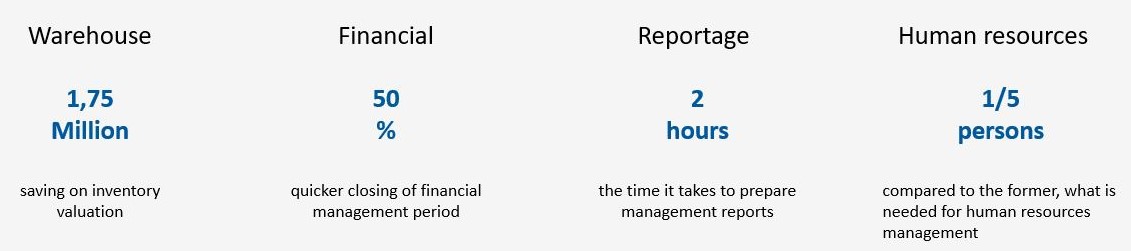
An international metal production and engineering company renewed its production environment. With the renewal, financial management, accounting and human capital management functions were consolidated and digitalized. Furthermore, the company’s production processes, warehouse management, and reporting were developed and improved.
The company works in 14 different countries and employs 560 employees. As a financial management solution, it chose the agile SAP S/4HANA. After the renewal, all necessary information is now consolidated. The employees can do their daily tasks from wherever whenever thanks to a new mobile application. For example, they can do purchase orders with their smart phones and approve requests from human resources.
The solution also included an MRP (Material Requirements Planning) process automatization. The cost savings were substantial. The new features in warehouse management delivered value savings of 1.75 million dollars. The time needed for a financial close was cut in half: from two weeks to a week. Lastly, whereas the company management used to get its reports in a week they now get them in two hours.
How to transition to S/4HANA?
It might not be easy to transfer critical functions to S/4HANA not to mention the cloud. Therefore, it is important to have a holistic view on the transition methods and waypoints.
Organizations can use S/4HANA on premise, in the cloud or as a hybrid solution. For those organizations that go with cloud, there are multiple options: S/4HANA can be used on SAP’s private Enterprise Cloud platform or in public cloud together with IaaS service providers such as AWS, Microsoft Azure or Google Cloud.
Besides choosing how to run the system, the organization must decide how the old system is transitioned to the new generation S/4HANA. Two popular options have been the conversion of the previous SAP ERP system to S/4HANA and a green field approach where S/4HANA is taken into use from scratch – just as if it was a new implementation.
Enterprises in Finland have chosen both options depending on their circumstances. Therefore, the most important thing is to first define what solution is the best for your organization. To determine this, an S/4HANA assessment is recommended to map organizational readiness to move towards an S/4HANA system.
Why to choose the cloud?
Cloud services offer its users the ability to capitalize on the latest innovations and optimize central organizational processes. Automatic system updates take place every quarter giving organizations better chances to utilize machine learning and predictive analytics. SAP S/4HANA Cloud offers integrated processes that are based on best practices.
The five pivotal advantages for organizations that have moved to SAP S/4HANA Cloud are:
- Faster execution times
- Support cost reductions
- The possibility to standardize complex processes and offer oversight.
- Standardization towards SAP strategic direction
- Flexible integration
We tell you gladly more about SAP S/4HANA.
Contact Information:
Piia Hoffsten
Chief Operating Officer
piia.hoffsten (a) isletgroup.fi
+358 40 5877 303
#SAP #S4HANA #isletgroup #SAPforbeginner #SAPnewbie #businesssuite #techsolutions