
SAP TechEd marked its 30th anniversary in Berlin on 27 – 29 October 2026. In the words of SAP’s CTO, the company is moving “from AI learning your business to running it.” The keynote turned the platform SAP announced earlier this year into concrete new capabilities for building, grounding and governing AI agents. Here is a summary of SAP’s most important announcements.

The opening keynote at Messe Berlin, 27 October 2026.
1. Joule Work and SAP Autonomous Suite
Joule Work is SAP’s AI user interface, where employees work with SAP and third-party data in their own language. At TechEd, SAP announced new agentic thinking capabilities that plan and orchestrate the steps needed to complete complex, multistep workflows across the SAP landscape.
SAP announced that SAP Autonomous Suite now offers 40 assistants and 300 agents across five horizontal domains, a count that includes those built by SAP’s partners. Each agent runs at one of three levels of autonomy chosen by the customer: human-in-the-loop, human-on-the-loop or fully autonomous.
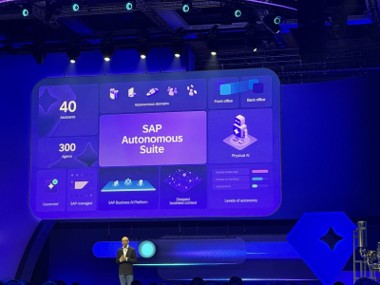
SAP Autonomous Suite at a glance.
2. Building agents: Joule Studio and open protocols
Joule Studio is SAP’s environment for building and extending agents, from no-code to pro-code. The new capabilities:
- New observability and administrative controls show agent behavior, model usage and spend.
- Developers can choose from more than 70 AI models, and early adopters can design and run n8n workflows in Joule Studio.
- Third-party agents can securely invoke Joule Agents through SAP’s agent gateway, which is now generally available. Every SAP agent is natively an A2A endpoint, and Joule Work supports open protocols such as A2A and MCP.
- SAP says moving from intent to a working agent now takes roughly 2.5 hours instead of 13, and its testing shows 50% lower cost per task.
- For select customers, running custom agents on the SAP-managed Joule Studio runtime is free through December 2026.
On the ABAP side, the focus was on agent-led development and custom code migration. SAP’s Mass S/4 Custom Code Conversion Agent identifies ABAP Test Cockpit findings and fixes them at scale, using deterministic rules or AI-generated changes.
SAP says moving from intent to a working agent now takes roughly 2.5 hours instead of 13, and its testing shows 50% lower cost per task.
3. SAP Business Data Cloud
SAP positions SAP Business Data Cloud (BDC) as the grounding engine that gives agents their business context. The new data announcements:
- SAP BDC Ontology Manager, available as beta, lets customers build ontologies that describe how data across SAP and third-party systems relates.
- Dremio brings native Apache Iceberg and Polaris support and a federated query engine that reaches data without moving or copying it. General availability of the new lakehouse capabilities is planned for Q1 2027.
- SAP’s partnership with Databricks expands: Lakeflow, Agent Bricks, Unity Gateway and Lakebase come into Business Data Cloud as SAP Databricks, together with a new SAP Application Data Foundation and an integration between Joule and Databricks Genie.
- SAP Reltio will bring multidomain master data management to Business Data Cloud, unifying customer, supplier and product records into trusted golden records.
- SAP Knowledge Graph will also cover each customer’s own SAP and non-SAP data, with general availability planned for Q1 2027.
- SAP-RPT‑2.0 adds anomaly detection and embeddings, with general availability planned for Q1 2027, and the new SAP-RPT-TS forecasts time-series metrics in SAP Integrated Business Planning. With HPE, SAP-RPT will also run aboard the International Space Station.
On stage, SAP showed its own TPC-DS benchmark results, in which Dremio ran selected one-terabyte workloads up to 47% faster and at up to 58% lower cost than comparable platforms on the same hardware. SAP also plans to roll out more than 850 SAP-managed data products over time.
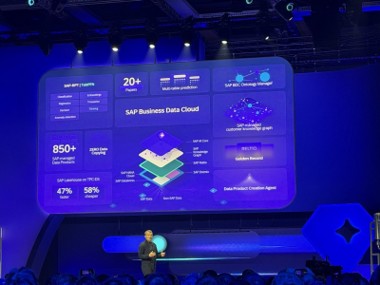
The Business Data Cloud stack: HANA Cloud, Databricks, Dremio, Reltio, Knowledge Graph and AI Core.
4. Physical AI by SAP
A humanoid robot and Spot, a four-legged robot, took the stage to introduce Physical AI by SAP, available now as part of Industry AI. Robots, drones and sensors take their tasks from SAP processes and report the results back into SAP as auditable records.
SAP’s customer examples include a humanoid robot handling inbound storage in SAP Extended Warehouse Management, and drones and robot dogs inspecting industrial assets, triggered by SAP maintenance plans.
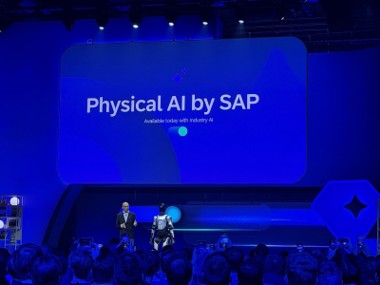
Physical AI by SAP, available today with Industry AI.
Robots, drones and sensors take their tasks from SAP processes and report the results back into SAP as auditable records.
5. Security and governance
- SAP Enterprise AI Gateway, built on SAP Integration Suite, brings authentication, policy enforcement, routing, monitoring, usage tracking and auditing of AI traffic across agents, tools, models and APIs into one place. General availability is planned for Q1 2027.
- A new AI Governance Assistant helps customers meet the requirements of the EU AI Act by producing an audit-ready AI risk classification. It is available to SAP Early Adopter Care customers from November 2026.
- SAP AI Agent Hub adds runtime verification, so agents that have not been verified in the hub cannot be invoked.
6. SAP Cloud ALM for AI agents
Announced at SAP Sapphire 2026 and covered in TechEd sessions, SAP Cloud ALM serves as the operational observability hub for AI agents within SAP AI Agent Hub. It traces agent sessions, monitors whether agents reach their goals and governs their lifecycle.
At Islet, we help put these innovations to work, whether it’s setting up your first Joule agent, reviewing authorizations before agents go live or building your data foundation. Get in touch to know more:

Tommi Luoto
CTO, Isletter
tommi.luoto@isletgroup.fi
+358 40 574 1261
Sources: SAP TechEd Berlin 2026 presentations, SAP News Center and the SAP TechEd 2026 Innovation News Guide.
#SAP #SAPTechEd #TechEdBerlin