
SAP recently introduced a Product Footprint Management solution (SAP PFM), that helps industrial organizations calculate and gain visibility on their footprint. The solution is a cloud-native application that calculates product footprints periodically and at scale considering the entire product lifecycle. With the help of the solution, companies can reduce their operations’ carbon emissions.
Organizations globally are in different phases in adoption of sustainability initiatives and compensating emissions. With SAP Product Footprint Management, companies gain insights on the environmental impacts of their products across the entire lifecycle. They can use these insights eg. for product and process optimization as well as internal and external disclosure and reporting. The solution reuses existing business data and combines it with environmental factors to calculate product footprints periodically and at a scale. The calculated footprints are integrated back into the end-to-end processes.

Example screen view of SAP Product Footprint Management solution
Benefits and business value of SAP PFM
SAP PFM helps companies calculate and monitor their carbon footprint levels and calculate the related business impact. It gives customers insights into product carbon footprints and enables actions to optimize them. We can expect carbon prices to skyrocket in the future, so it is important for industrial companies to take control of the entire product lifecycle and manage the related emissions efficiently based on reliable and timely data.
Operating environmentally-consciously is very important in fighting climate change. Customers and employees also expect companies to reduce their negative impact on the planet. Climate change is a threat to the future of our planet, and every organization should adapt to mitigate its effects. With the help of SAP Product Footprint Management, an organization can become an industry forerunner in reducing their emissions on product level. Companies use SAP PFM solution also to calculate, analyze and present results to meet government requirements and regulations.
SAP PFM reduces the effort and cost of calculating, analyzing, and reporting product footprints. With simplified calculation method using the pre-configured templates, the solution also frees up internal resources for more value adding work. SAP PFM is easy to implement and intuitive to use and eliminates the mistakes coming from manual work.
Key capabilities of SAP PFM
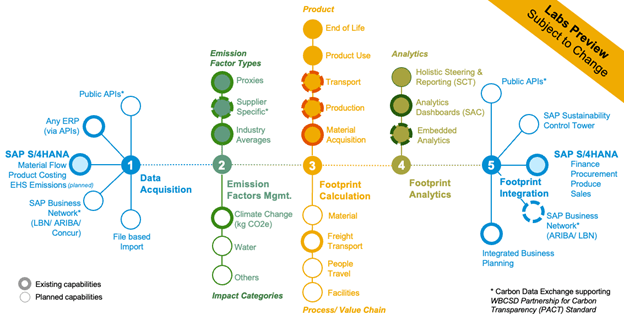
SAP Product Footprint Management — Product Capabilities
Source: SAP Product Footprint Management: Q4-22 Updates & Highlights | SAP Blogs
- Data Acquisition
Integrating master data from SAP S/4HANA / SAP Business ByDesign – reusing already available and validated data.
- Emission Factors Management
Importing emission factors from lifecycle assessment data to calculate footprints at scale across the entire product inventory. For now, data is retrieved from SAP Life Cycle Assessment (LCA) database or is re-using data from LCA database providers such as Ecoinvent. Later on, the plan is to use the data directly from the suppliers.
- Footprint Calculation
Using a pre-configured footprint calculation template, you can define the products to add to the calculation pairing, each product with its emission factor (both purchased materials and raw materials for production), thus having an overview of the carbon emission during a product lifecycle.
Adding transport activities, the company will get a reliable footprint value of their purchase (indicated in the Purchase Order).
From the management perspective, the solution provides a built-in governmental carbon price calculation for better budgeting and planning.
- Footprint Analytics
Scoring and Analytics helps to easily understand product footprint information — to deep dive into the product level and see which component has the biggest footprint impact and based on that decide whether to change supplier or production method.
- Footprint Integration
SAP’s end-to-end business processes can be extended by embedding product footprint information covering greenhouse gas emissions.
In case you want to know more about the solution, contact us!

Janina Luoto
CEO, Isletter
janina.luoto@isletgroup.fi
+358 40 574 1266
Also, Islet has developed an emission calculation and reporting application
Read the reference story: Islet Developed an Emission App for Transmeri Group to Advance their Sustainability Efforts
#Sustainability #CarbonEmissions #ProductFootprint #FootprintManagement #SAP #SAPProductFootprintManagement #SAPPFM #EmissionCalculation #Emission #ClimateAction #ProductLifecycle